

How a focused AI proof of concept helped translate a proven educational methodology into a teacher-centered assessment experience.

Overview
Project ARC has spent years developing a methodology for authentic learning and assessment, helping educators evaluate not only what students know, but how they apply their knowledge through projects, performances, and other authentic work.
Its earlier ORCHAReD platform put that methodology into practice by allowing educators to provide standards, rubrics, assessment criteria, and student work and receive detailed student and teacher reports. While the original technology was no longer maintained, Project ARC retained the intellectual foundation: its methodology, prompts, frameworks, workflows, and experience applying them with educators.
With advances in generative AI, Project ARC saw an opportunity to revisit that vision. Flexion partnered with Project ARC to explore a fundamental question: Could AI help scale Project ARC’s expertise while keeping feedback grounded in its methodology and educators firmly in control?
Challenge
Generative AI can produce feedback quickly. Producing feedback that educators can trust is a much harder problem.
Project ARC’s approach to assessment goes beyond generating a score or generic comments. Feedback should be specific, actionable, age-appropriate, instructionally meaningful, and grounded in the standards, criteria, and context of the assignment. The goal is to help students understand both their strengths and where to go next.
At the same time, Project ARC’s vision extends beyond individual student feedback. Authentic assessment can generate valuable information for teachers: patterns across a classroom, students struggling with particular skills or standards, opportunities for reteaching, and evidence of growth over time.
The challenge was therefore not simply to ask an AI model to “grade” student work.
The team needed to determine whether AI could operate within a bounded instructional framework, using Project ARC’s methodology, teacher-provided context, standards, rubrics, and assessment criteria, to generate useful insights without replacing professional educator judgment.
That led to several key questions:
Can AI-generated feedback reflect the quality and specificity of Project ARC’s methodology? Can outputs remain grounded in the standards and assessment criteria educators provide? Will teachers find the feedback useful and trustworthy? And can individual student analysis become the foundation for meaningful classroom and eventually school- or district-level insights?
Approach
Flexion and Project ARC began with a focused proof of concept (POC) designed to test the highest-risk assumptions and inform the path toward a future product.
The team reviewed Project ARC’s existing methodology, Authentic Project Learning Experiences (APLEs), sample assessments, standards, rubrics, and examples of reports from the previous ORCHAReD platform. Those materials provided both the instructional foundation for the new experience and a benchmark for evaluating AI-generated outputs.
From there, Flexion translated the methodology into a modern workflow:
Teacher provides assignment context, standards, rubric/criteria, and student work → ORCHAReD evaluates the work → AI generates draft findings and feedback → teacher reviews and validates the analysis → approved feedback becomes the foundation for broader instructional insights.
Grounding AI in Project ARC’s methodology
Instead of treating AI as an open-ended evaluator, the POC explored a constrained approach grounded in Project ARC’s instructional framework and teacher-provided materials.
The system uses the assignment context, standards, rubrics, assessment criteria, and Project ARC methodology as the basis for evaluation. The goal is to increase consistency and instructional alignment while reducing the risk of unsupported or generic AI responses.
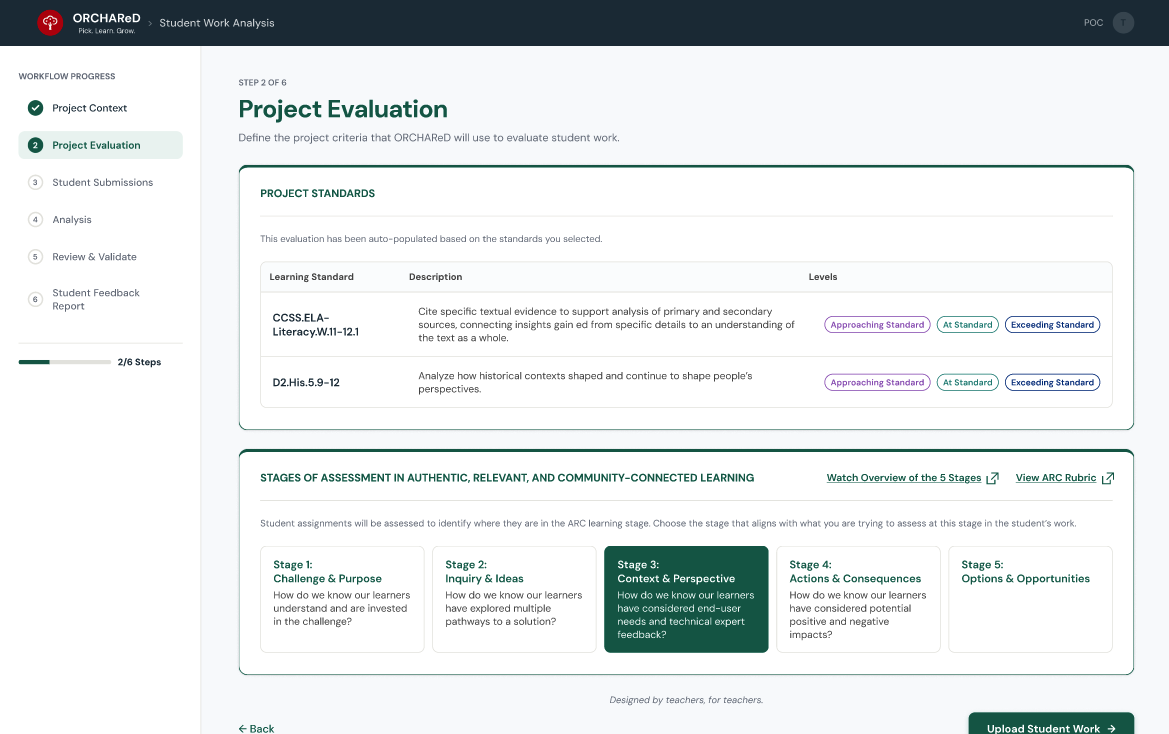
Educators define the context for the assessment, including the learning standards and criteria against which student work should be evaluated.
Keeping educators in control
Teacher oversight was treated as a core part of the experience, not an afterthought.
AI-generated analysis is presented as a draft for educator review. Teachers can inspect the student evidence alongside the evaluation, refine or regenerate feedback, and approve or reject the results before they become final.
This human-in-the-loop model supports Project ARC’s larger philosophy: AI should amplify teacher expertise, strengthen educator practice, and support professional judgment, not replace it.
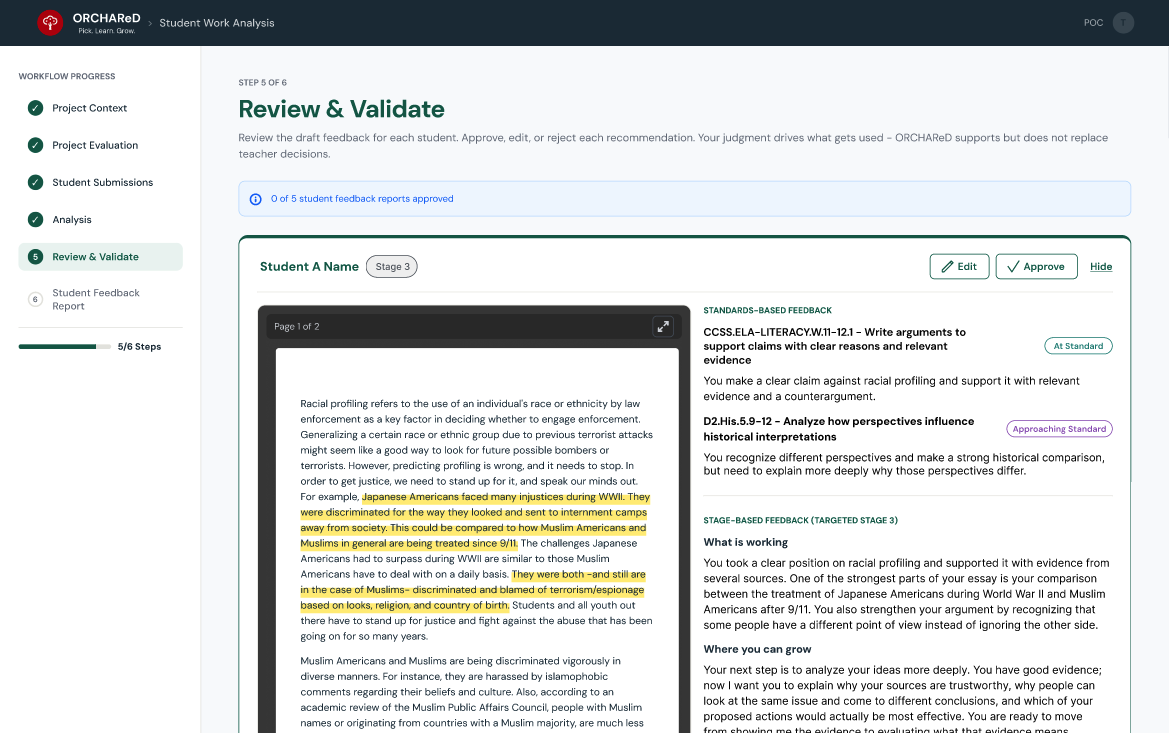
Teachers review student evidence alongside AI-assisted standards analysis,
maintaining control over the final evaluation and feedback.
Outcomes
The POC moved Project ARC’s methodology from a conceptual AI opportunity into a tangible product experience that could be explored, tested, and refined.
From student work to actionable feedback
At the individual student level, ORCHAReD demonstrates how authentic student work can be analyzed against defined standards and assessment criteria and through Project ARC’s own assessment framework, then translated into feedback designed to help students understand both current performance and next steps.
Rather than emphasizing a single score, the experience is designed around strengths, areas for growth, reflection, and actionable next steps, consistent with Project ARC’s approach to authentic assessment.
Today, the platform represents more than a conference application, it is a flexible engagement framework that can be adapted for conferences, trade shows, museums, visitor centers, educational institutions, corporate campuses, and other environments where contextual knowledge and natural interaction can improve the user experience.
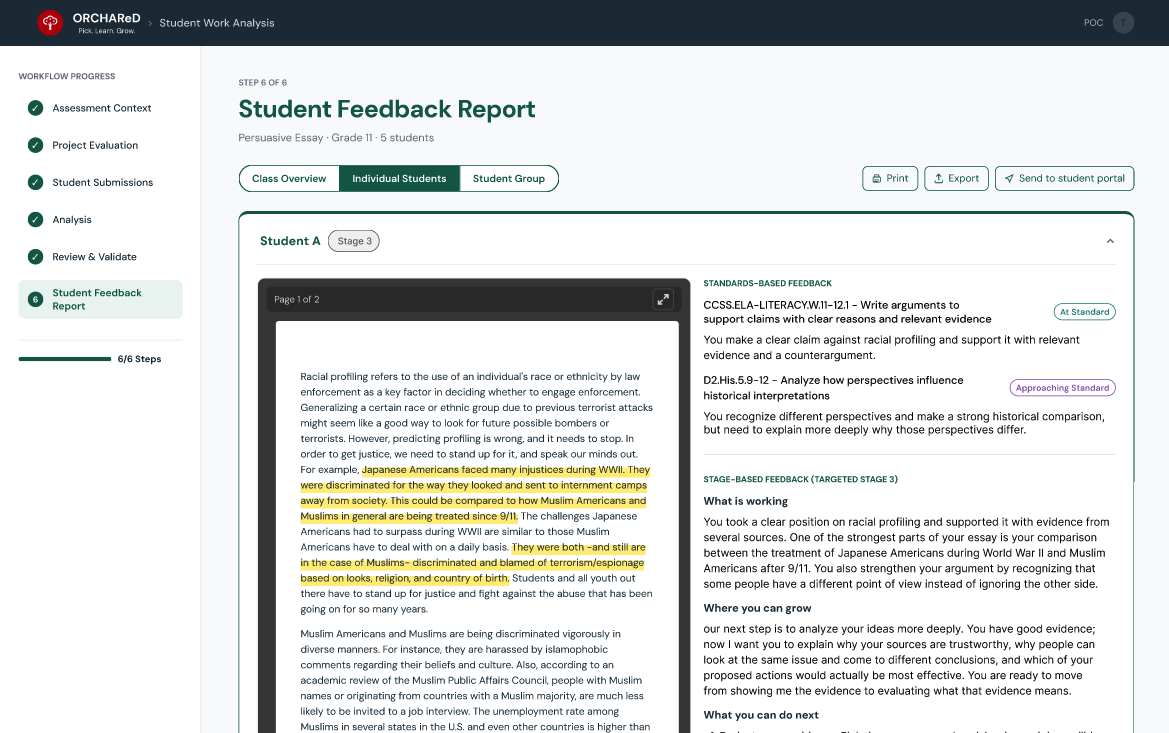
Student feedback connects performance against specific learning standards with actionable next steps and reflection prompts.
Turning individual analysis into classroom intelligence
The work also began exploring what happens after individual student evaluations are reviewed.
Once educators trust the underlying student-level analysis, those results can be aggregated to reveal patterns across a class: which students are approaching, meeting, or exceeding a standard; which skills may require reteaching; and where groups of students may benefit from similar instructional support.
This shifts the value proposition from simply generating feedback faster to helping teachers answer a more useful question:
What does all of this student work tell me about what I should do next?
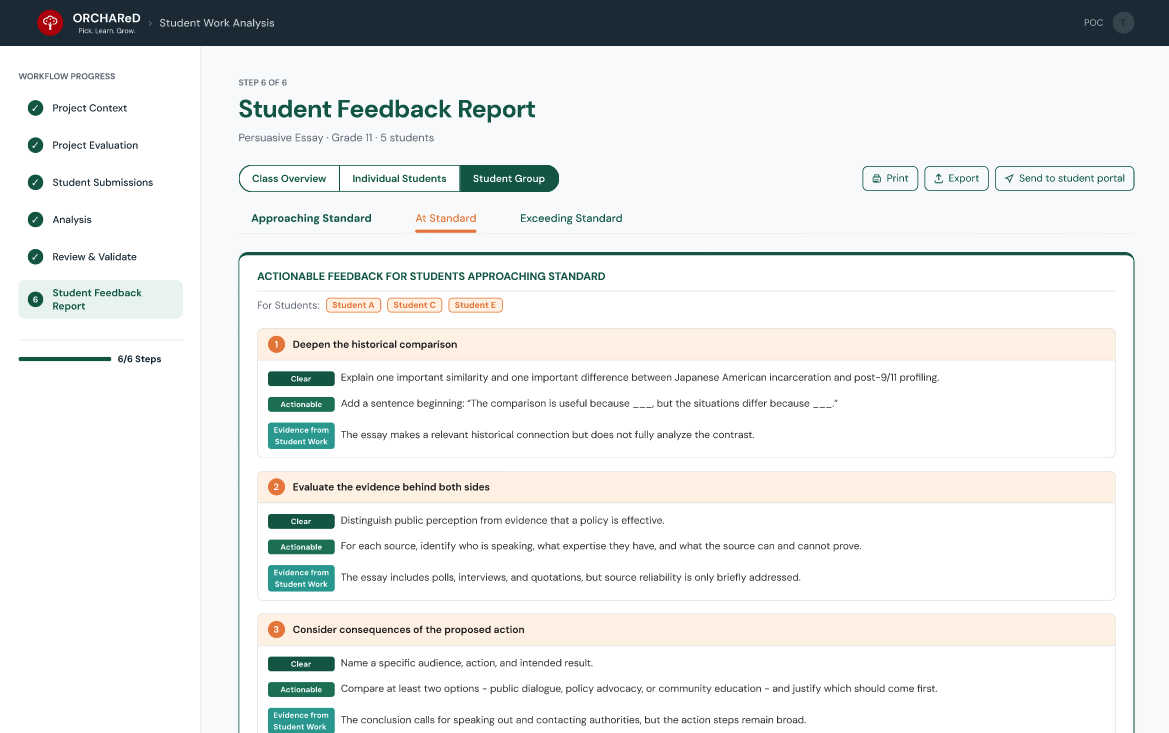
Aggregating validated student results begins to reveal patterns educators can use to identify instructional priorities and target support.
Designing for authentic assessment, not just traditional assignments
Because Project ARC focuses on authentic learning, the longer-term opportunity extends beyond essays or conventional assessments.
The same underlying model could eventually support projects, presentations, discussions, demonstrations, and other forms of authentic student work, creating a richer picture of student learning than traditional assessment alone.
Impact
The POC established a foundation for turning Project ARC’s assessment methodology into a modern AI-supported product.
Just as importantly, the work helped sharpen the product vision.
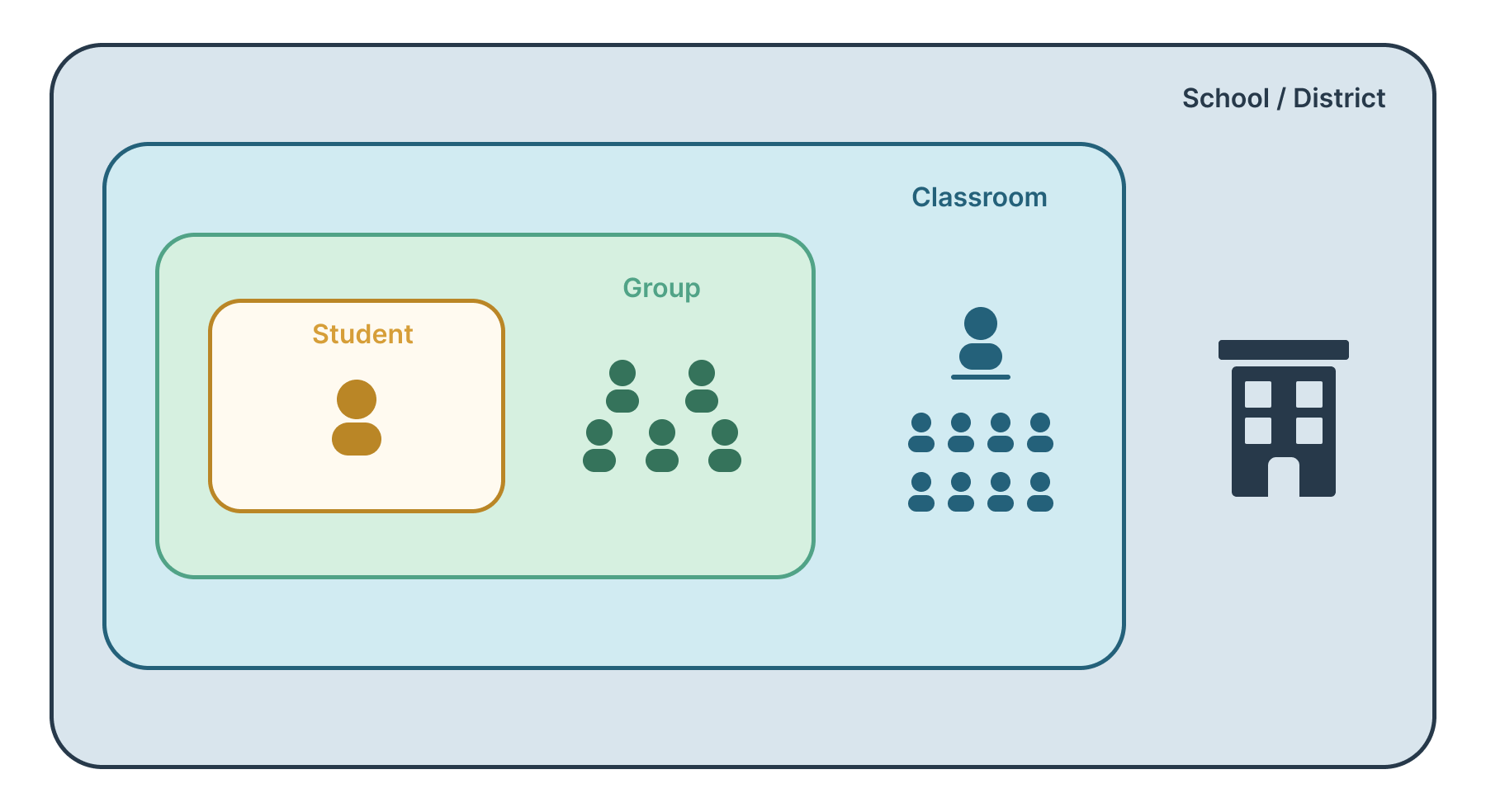
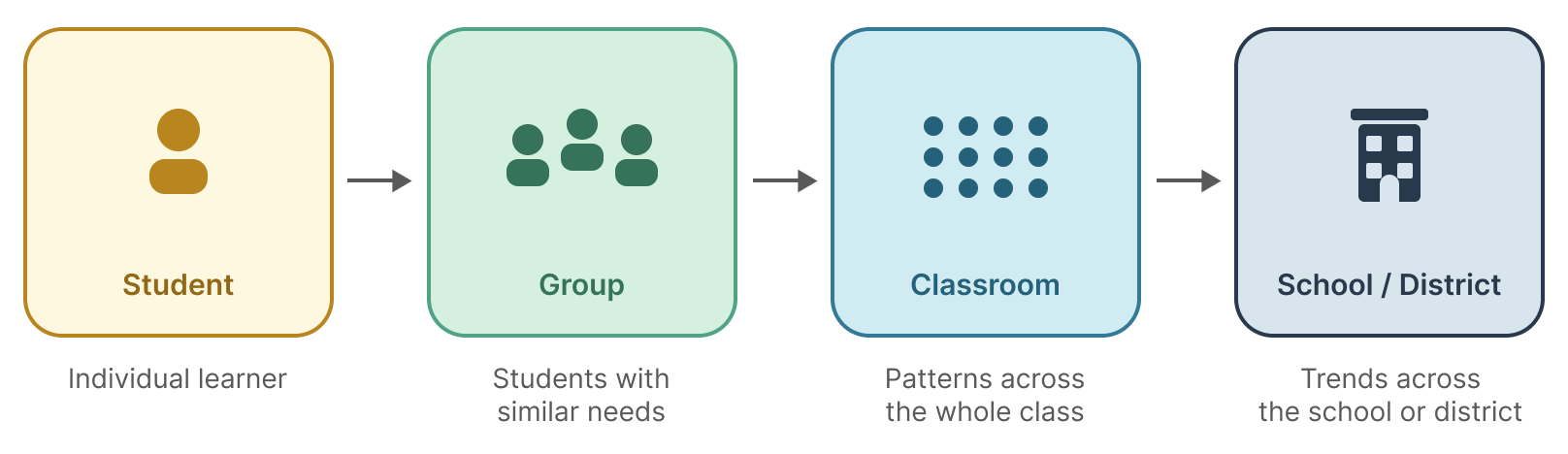
The opportunity is larger than automating an existing report. The underlying value comes from creating a connected assessment intelligence system in which each level builds on trusted evidence from the level below:
Student → Group → Classroom → School / District
Student
Provide specific, standards-aligned feedback on authentic work.
Group
Identify students with similar strengths, needs, or instructional opportunities.
Classroom
Surface patterns across standards and criteria to help educators decide where to reteach, reinforce, or extend learning.
School / District
Over time, aggregate validated evidence to understand learning trends, standards coverage, growth, and instructional needs at scale.
This progression also reinforces an important product principle surfaced through the work: higher-level insights are only valuable if educators trust the individual analysis underneath them.
The POC therefore focused first on establishing the workflow and instructional foundation needed to support that trust and enable broader assessment intelligence.
What’s next
The next step is to put the POC into the hands of educators and test it with authentic classroom use cases.
Beta testing can help Project ARC evaluate the accuracy and usefulness of the feedback, the effectiveness of the teacher review and validation workflow, and whether the grouping and classroom insights help educators make better instructional decisions.
From there, the product could expand in several directions.
Longer-term opportunities identified through the work include teacher coaching and professional growth, classroom-level misconception and pattern analysis, standards mastery and coverage, longitudinal student growth, school- and district-level reporting, additional forms of authentic student evidence, and integrations with schools’ and districts’ existing education technology ecosystem.
Moving toward production would also require the product capabilities expected of a scalable education platform, including secure user accounts and roles, student privacy protections, monitoring, AI safeguards, and the infrastructure needed to support broader adoption.
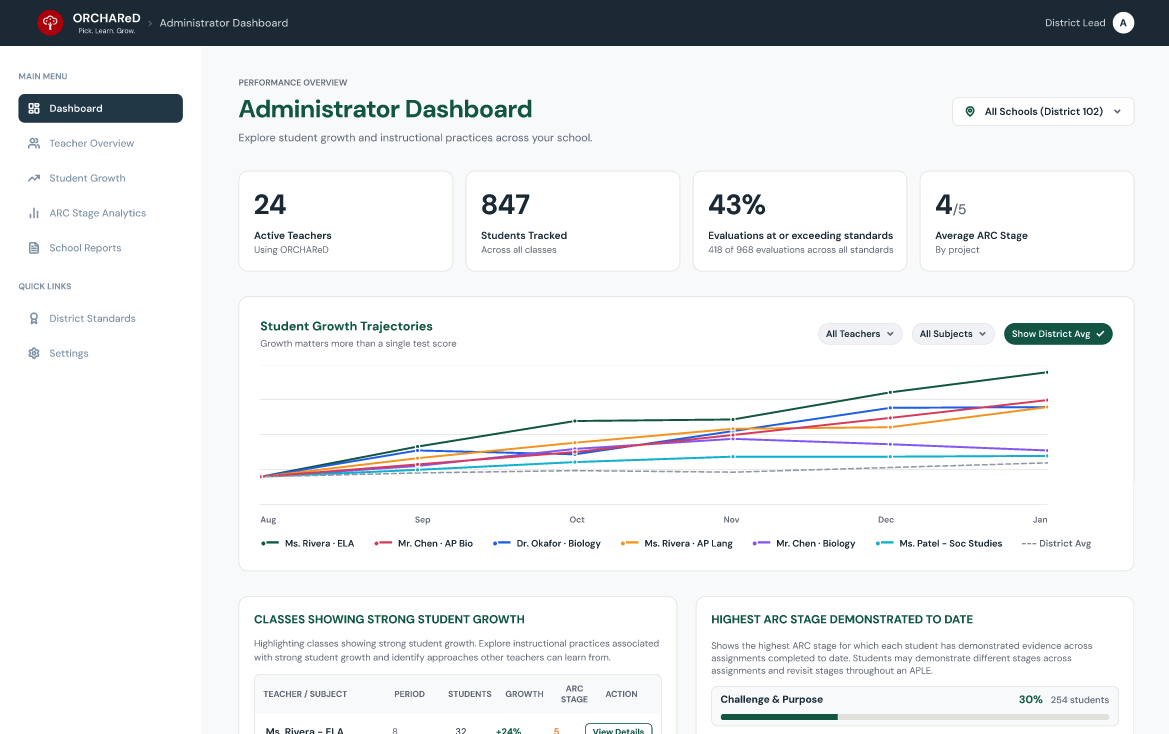
Future iterations can connect individual assessment evidence to longitudinal classroom,
school, and district insights.
Conclusion
Project ARC began with a valuable asset: years of expertise in authentic learning and assessment, along with a methodology designed to make student feedback more meaningful.
Flexion helped explore how that expertise could be translated into a modern AI-supported product.
The resulting proof of concept demonstrates a path toward an assessment experience where AI does more than generate feedback. It helps educators analyze authentic student work against meaningful standards and through Project ARC’s assessment methodology, keeps teachers in control of the final judgment, and creates a foundation for identifying patterns that can inform instruction at increasingly larger scales.
The work also surfaced a broader product opportunity: turning authentic assessment into assessment intelligence.
By beginning with trusted student-level evidence and building upward, from student, to group, to classroom, and eventually school and district, ORCHAReD has the potential to help educators not only understand how students performed, but decide what to do next.