Rethinking career pathways as public digital infrastructure
Flexion’s vision, supported by early working prototypes and design artifacts

States, districts, and regional workforce organizations are increasingly focused on demonstrating that investments in career readiness lead to real jobs, wages, and economic mobility. Yet most career pathway efforts remain fragmented, spread across disconnected systems, proprietary tools, and short-term pilots that are difficult to sustain or scale.
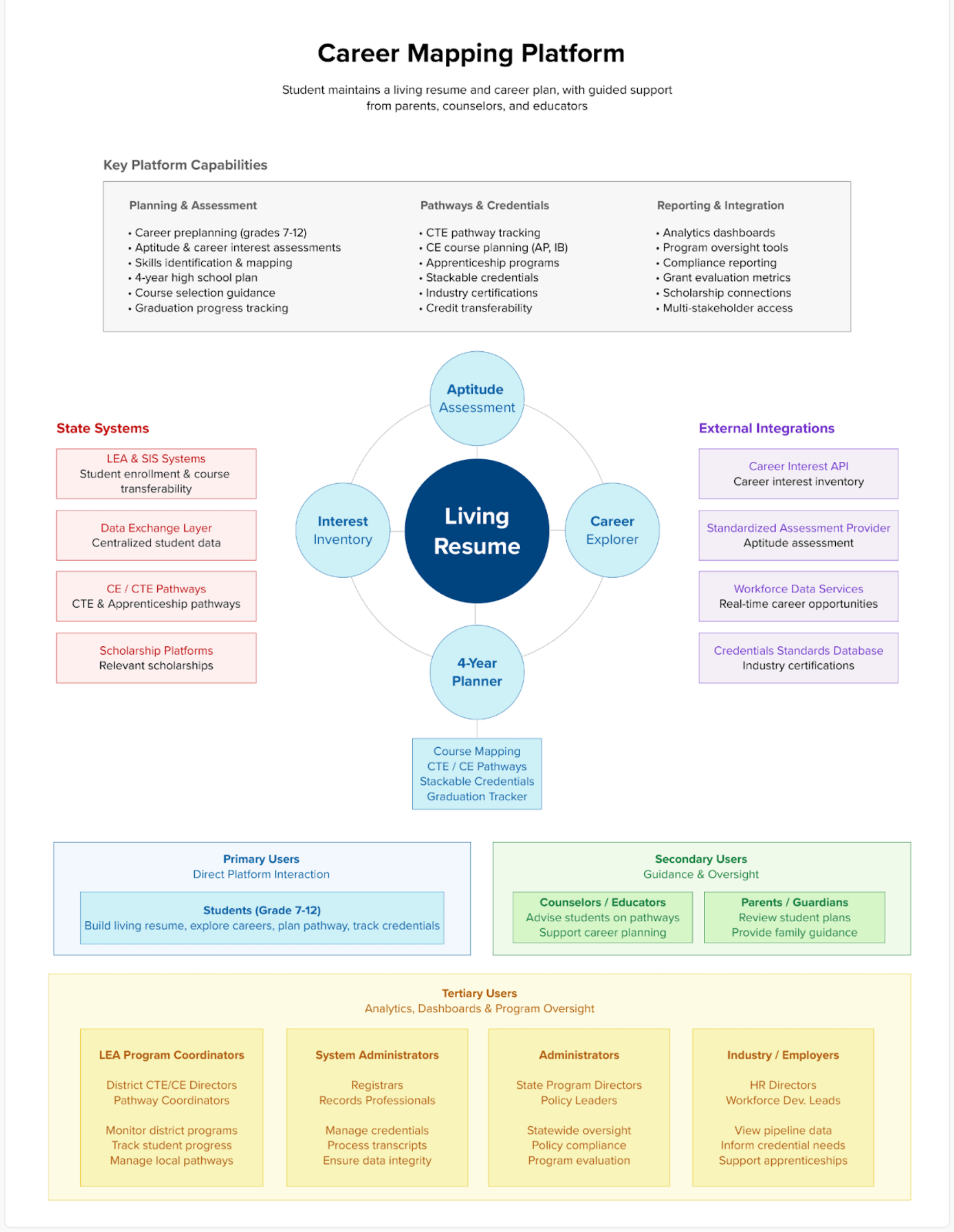
Flexion is working with public-sector leaders to design and build a career pathway platform as public infrastructure: open, interoperable, and owned by the state or region. Rather than replacing existing systems, this infrastructure connects them to align employer demand, learner skills, paid work experience, and community-level outcomes in a single, trusted ecosystem.
Challenge
Across education and workforce systems, the same challenges appear again and again:
- Employers struggle to identify candidates with verified, job-ready skills
- Students and job seekers can’t see clear, achievable paths from learning to employment
- Credentials are earned but not easily interpreted or trusted across systems
- Boards and funders lack visibility into return on investment beyond participation counts
- Education and workforce providers face shifting funding environments and struggle to deploy sustainable, accessible technology that connects learning to real career outcomes
Most technology solutions address only one slice of the problem, like career exploration, résumés, or analytics, and often through proprietary platforms that introduce long-term lock-in and duplication.
Opportunity
Flexion saw an opportunity to reframe career pathways as public digital infrastructure, similar to transportation or broadband systems:
- Built once
- Governed locally
- Integrated with existing institutions
- Reusable across programs, sectors, and funding streams
- State or regional ownership of data, code, and cloud environment, ensuring long-term control, portability, and privacy safeguards
The goal was to demonstrate that this model could be both visionary and practical, supported by working software, real user experiences, and measurable outcomes.
Approach
1. Open architecture, owned by the public
Flexion designed the platform as state infrastructure, not a vendor-controlled product.
- Privacy-first architecture with stakeholder ownership of data, clear governance, and transparent access controls
- API-first, modular architecture
- Alignment with open standards (CTDL, LER, CLR, VCs, Open Badges)
- Designed to integrate with existing SIS, LMS, credential registries, and workforce systems
This approach avoids vendor lock-in while allowing regions to evolve their systems over time as policies, partners, and labor markets change.
Long-term cost sustainability
State-owned, open infrastructure shifts spending from recurring licensing fees to predictable, controllable investments in shared public assets.
Rather than paying indefinitely for access to proprietary platforms, states invest once in core infrastructure and extend it over time, which adds integrations, features, and partners without renegotiating ownership or escalating per-user costs. This model is designed to lower the total cost of ownership, reduce risk as participation grows, and support long-term sustainability across administrations, funding cycles, and policy changes.
2. The student living resume, digital wallet, and pathway
At the center of the ecosystem is a student living resume, a dynamic, verified record that grows over time as learners:
- Complete career interest and aptitude assessments
- Plan and adjust career pathways
- Complete coursework and short-term learning
- Access industry-recognized credentials
- Participate in internships or apprenticeships
- Access to verifiable labor market and occupational data
Rather than a static resume, the living resume is continuously updated, interoperable, and employer-readable.
The resume is paired with a pathway planner that helps learners make informed decisions about their first step and their next step:
- Whether they are on track for their goals
- Which skills or credentials are missing
- How learning, paid work, and wages connect over time
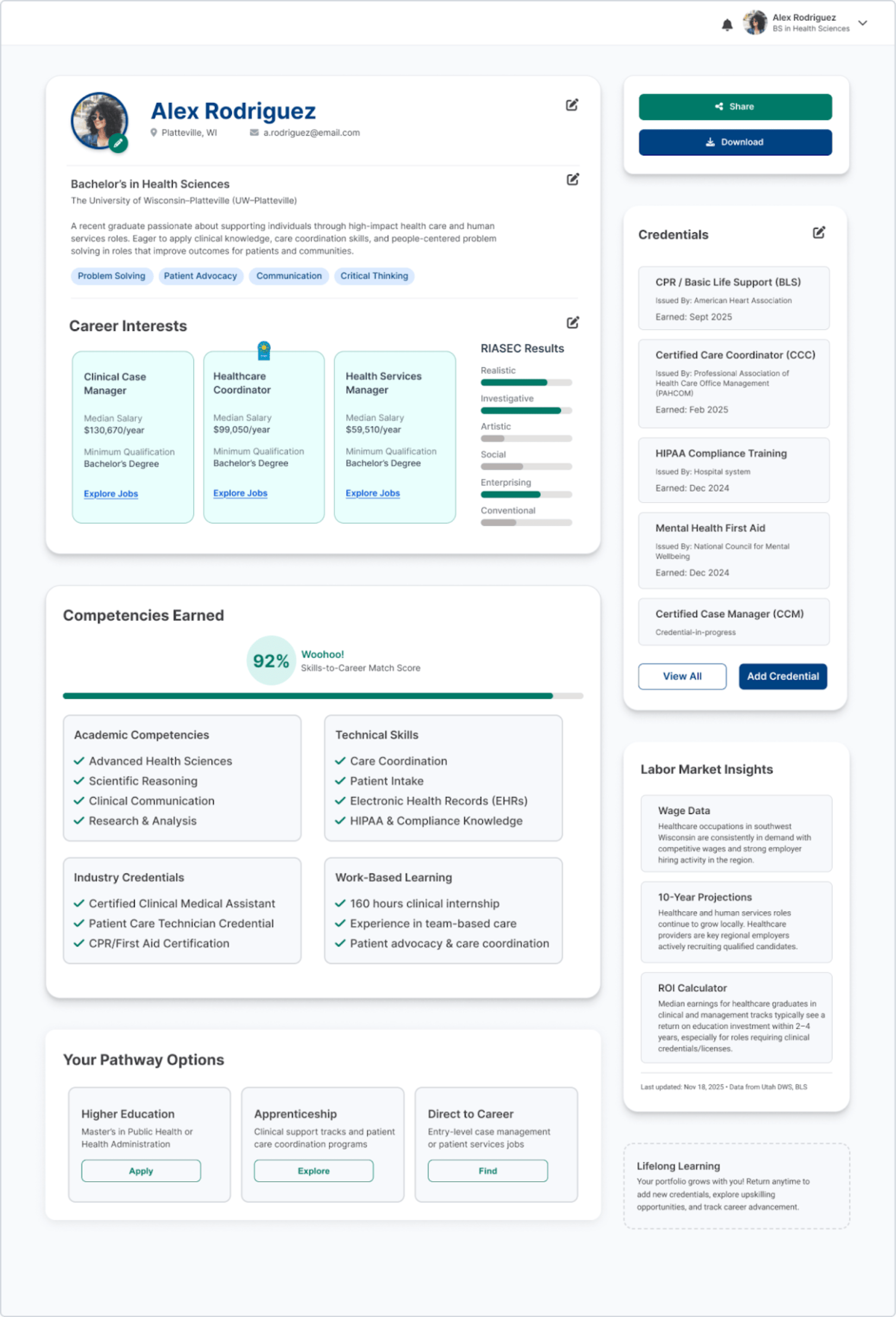
Example: Alex Rodriguez
Alex, a recent health sciences graduate, uses the platform to:
- Visualize multiple pathways (direct-to-career, apprenticeships, graduate study)
- Track a 92% skills-to-career match score
- Track, store, and share credentials in one portable, cryptographically signed wallet using W3C VC 2.0 + Open Badges 3.0 standards
- See progress toward employment goals
3. Measuring ROI with district and community dashboards
To support decision-making beyond the individual learner, Flexion designed dashboards that shift focus from activity tracking to economic impact.
District-level dashboards surface:
- Learner engagement and progression
- Credential attainment
- On-track / off-track indicators across pathways
- ROI
ROI is calculated by connecting learner progression and credential attainment to employment outcomes, wage data, and regional demand indicators.
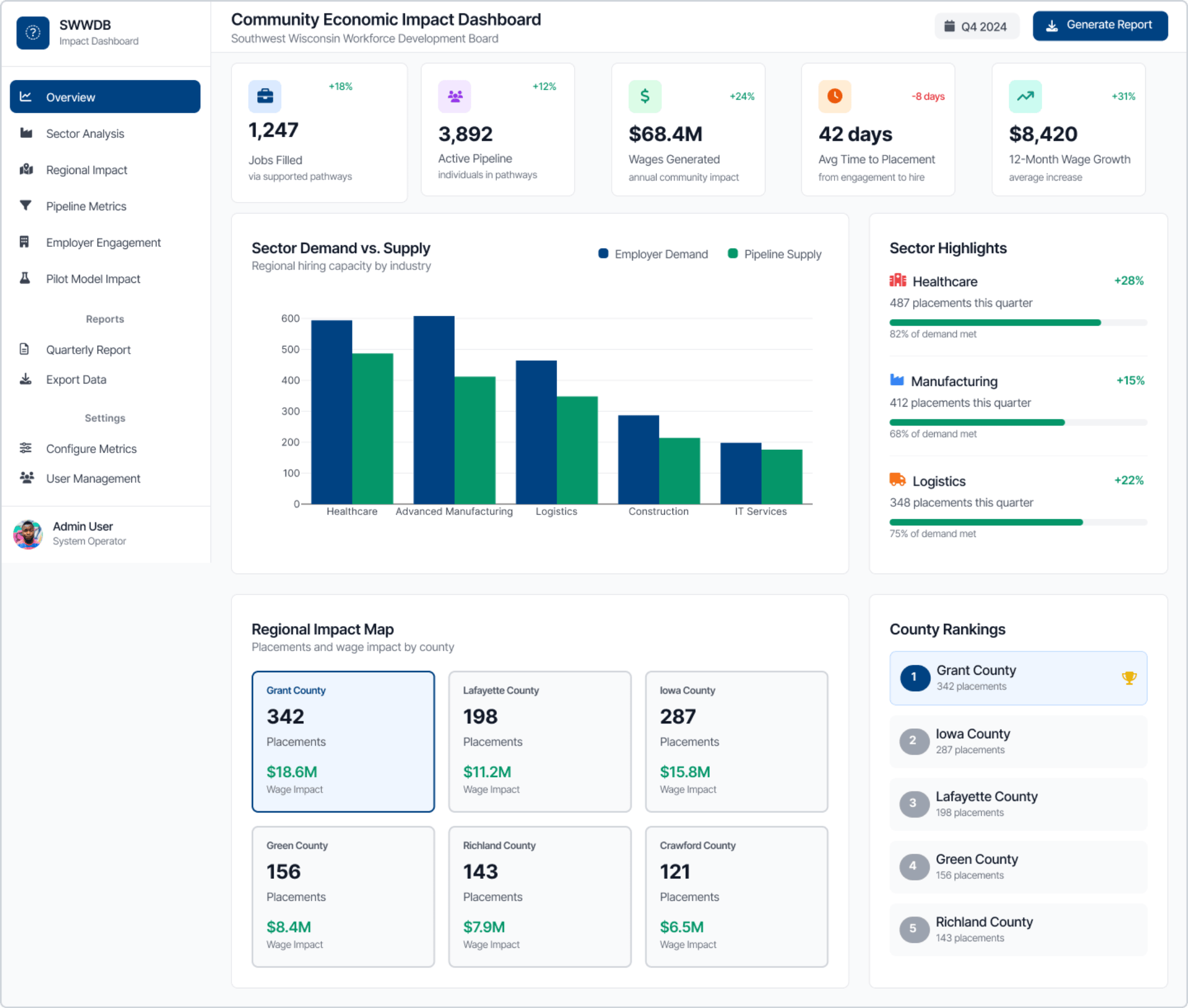
Community Economic Impact dashboards aggregate outcomes across sectors and regions, including:
- Jobs filled via supported pathways
- Active pipeline size
- Wages generated
- Average time to placement
- Wage growth and retention
- Sector demand vs. pipeline supply
In Southwest Wisconsin, for example, the dashboard shows sector-level gaps between employer demand and pipeline supply, alongside metrics such as $68.4M in annual wages generated and 42-day average time to placement.
From strategy to working software
To demonstrate feasibility, Flexion developed a series of working prototypes and proofs of concept:
- RIASEC career interest survey (working software)
Designed and built by a small Flexion team in two weeks, demonstrating rapid delivery and integration readiness. - Student living resume (high-fidelity prototype)
Figma designs showing verified skills, credentials, pathway status, and employer-facing signals. - Pathway visualization & planner (prototype & working software In progress)
A pathway planning tool that allows learners and job seekers to map learning, credentials, and paid experience toward target careers - District & community dashboards (high-fidelity prototype)
Interactive prototypes illustrating how learner progress connects to hiring, wages, and regional economic outcomes.
These artifacts enabled stakeholders, including state agencies, district leaders, and workforce organizations, to engage with live software rather than just slides.
Early signal and stakeholder response
Although still in early-stage deployment, this work has already:
- Demonstrated a viable alternative to proprietary career platforms
- Validated stakeholder interest in portable, trusted learner records
- Provided a framework for measuring ROI beyond participation counts
- Sparked conversations with state agencies, workforce organizations, and philanthropies
Explore this model further
If you are a state agency, district leader, workforce board, or philanthropic organization interested in state-owned career pathway infrastructure, we welcome a conversation.
Why Flexion
Flexion brings a rare combination of:
- State- and federal-scale public sector delivery, paired with deep commercial and nonprofit EdTech experience
- Deep expertise in career readiness, credential interoperability, and standards
- Human-centered product design and delivery powered by a multidisciplinary team of ~250 designers, researchers, engineers, and product and delivery leaders, including a dedicated EdTech practice
- Rapid prototyping that turns policy ideas into working systems
The result is a durable, adaptable career pathway infrastructure that is owned by the public and designed to grow over time with learners, employers, and communities.
Ready to change the way you’re doing business?
Contact us to talk about how Flexion can help your organization drive efficiency, optimize costs, and achieve your technology goals!