

The power of Adaptive Software Delivery
Do you know what Chegg and the Veterans Affairs (VA) have in common? Both struggled because their systems couldn’t adapt fast enough to unexpected change.
- Chegg lost nearly 50% of its stock value when ChatGPT disrupted its homework-help model. Though aware of AI’s rise, the company delayed adopting generative AI, clinging to legacy subscriptions while competitors like Khan Academy adapted quickly.
- The VA halted its Electronic Health Record (EHR) modernization, leaving veterans dependent on outdated systems. By failing to incorporate clinician feedback promptly, usability issues persisted, hindering care improvements.
These stories point to a larger truth: disruption often stems not from change itself, but from the inability of software systems to adapt.
What if your software could thrive in chaos? What if volatility became a competitive advantage, one that goes beyond what agile alone delivers?
What adaptive software delivery really means
A biological ecosystem adapts through constant, massively parallel experimentation, with many genetic lines competing to outlast the others. Those with traits that best handle the stressors of their environment are amplified, while those with less effective characteristics are dampened. The ecosystem continuously adapts to match the environment.
Similarly, adaptive software delivery continually tests multiple options at multiple levels. These can include user experiences, technical architectures and designs, new technologies, and team processes. The delivery system is an ecosystem that continuously creates and evaluates such options at every level. With proper discipline, the system evolves, seizing opportunities and avoiding periodic overhauls.
A tale of two teams
Agile software delivery systems quickly move from one place to an adjacent one, while adaptive systems are in many places at once.
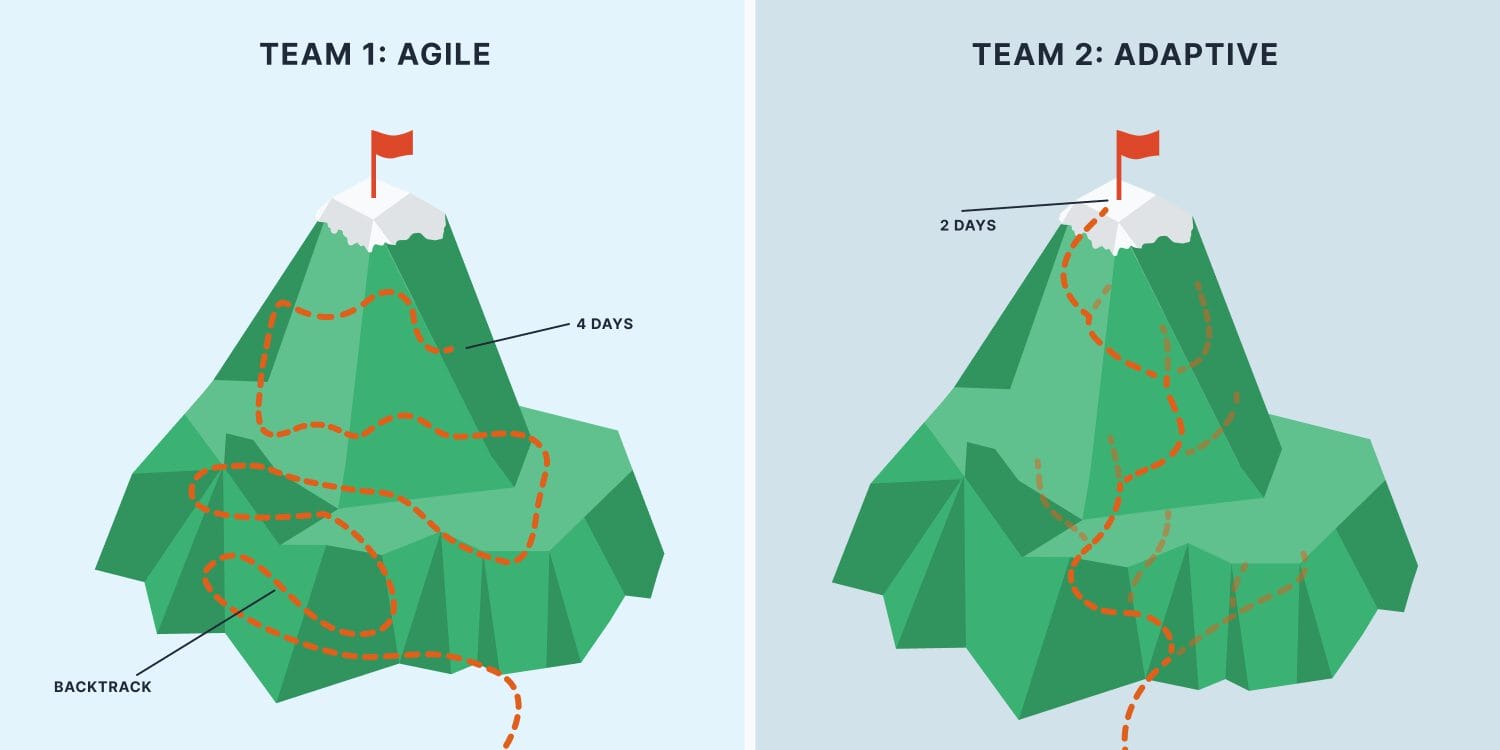
To illustrate, imagine two teams of experienced explorers, both heading toward a destination through unknown terrain. The goal is clear, but the way forward is filled with challenges: obstacles, unpredictable weather, and changing landscapes.
Team 1, the agile squad, sticks together and adapts as barriers appear, moving forward steadily. However, if a major obstacle, like a raging river or chasm, blocks them, they must backtrack, wasting time.
Team 2, the adaptive crew, splits into smaller groups, each probing different paths. As subgroups test new paths, hitting an obstacle doesn’t stop progress; others continue. Success doesn’t rely on one path; it’s distributed, ensuring a viable route emerges on time.
Is adaptive delivery efficient?
Every journey involves two modes: search (exploring and evaluating paths) and execution (following established routines). While software delivery blends both, searching for solutions at multiple levels dominates software development schedules. Using the wrong mode in the wrong situation causes inefficiency and failure.
Critics ask, “Is exploring multiple solutions simultaneously efficient?” Efficiency depends on the mode. In execution mode, it means no wasted motion. But in search mode, investigating seemingly wrong paths appears as wasted motion, but this exploration is necessary, as you can’t know a path is a dead end until you walk it. Exploring multiple paths concurrently enables you to look in more places more quickly. True inefficiency in search mode arises from pursuing known dead ends or running out of time or money.
People already use adaptive techniques in obviously uncertain contexts. For example, when hiring to fill an open position quickly, we’ll pipeline several candidates simultaneously, advancing some, and dropping others. The difference in software systems delivery is that most development organizations lack the social and technical principles and methods to make option generation systematic and affordable.
Adaptive vs. Agile in software delivery
In software delivery, the true battleground is the “search” for viable business or technical paths amid evolving needs, tight deadlines, or fierce competition.
Agile teams typically operate like Team 1: a predefined roadmap forms an “exoskeleton” that constrains the search area (which assumes the context is stable enough to know a feasible route in advance). Maneuvering within this search area happens as user stories are defined, elaborated, and implemented. When surprises hit and time is short, sacrifices follow, usually to scope and quality.
Adaptive delivery mirrors Team 2: a goal is defined, and the team is free to pursue many paths simultaneously. Whenever uncertainty arises at any granularity, in any part of the system, they explore multiple options. These may include alternative user experiences, AI agents, utility libraries, algorithms, integration frameworks, or other relevant components. Feedback loops quickly amplify what works and drop what doesn’t. Unlike journeys across mountainous terrain, in the digital world, abandoning a dead-end path is cheap.
For example, when building a claims validation system for one of our data system modernization projects, we implemented an architecture that makes it easy to seek options. Not knowing which runtime would best balance cost and flexibility, we ran production loads simultaneously in three AWS contexts: Lambda, EC2, and AWS Batch. As claims volume grew and systems were stressed, we dropped the underperformers, leaving AWS Batch as the preferred option. This was not guesswork. It was code that evolved and scaled without the usual hassles of rework.
Turning risk into opportunity
Uncertainty presents opportunity. When faced with complexity, organizations benefit from increasing optionality, transforming risk into a source of strategic advantage.
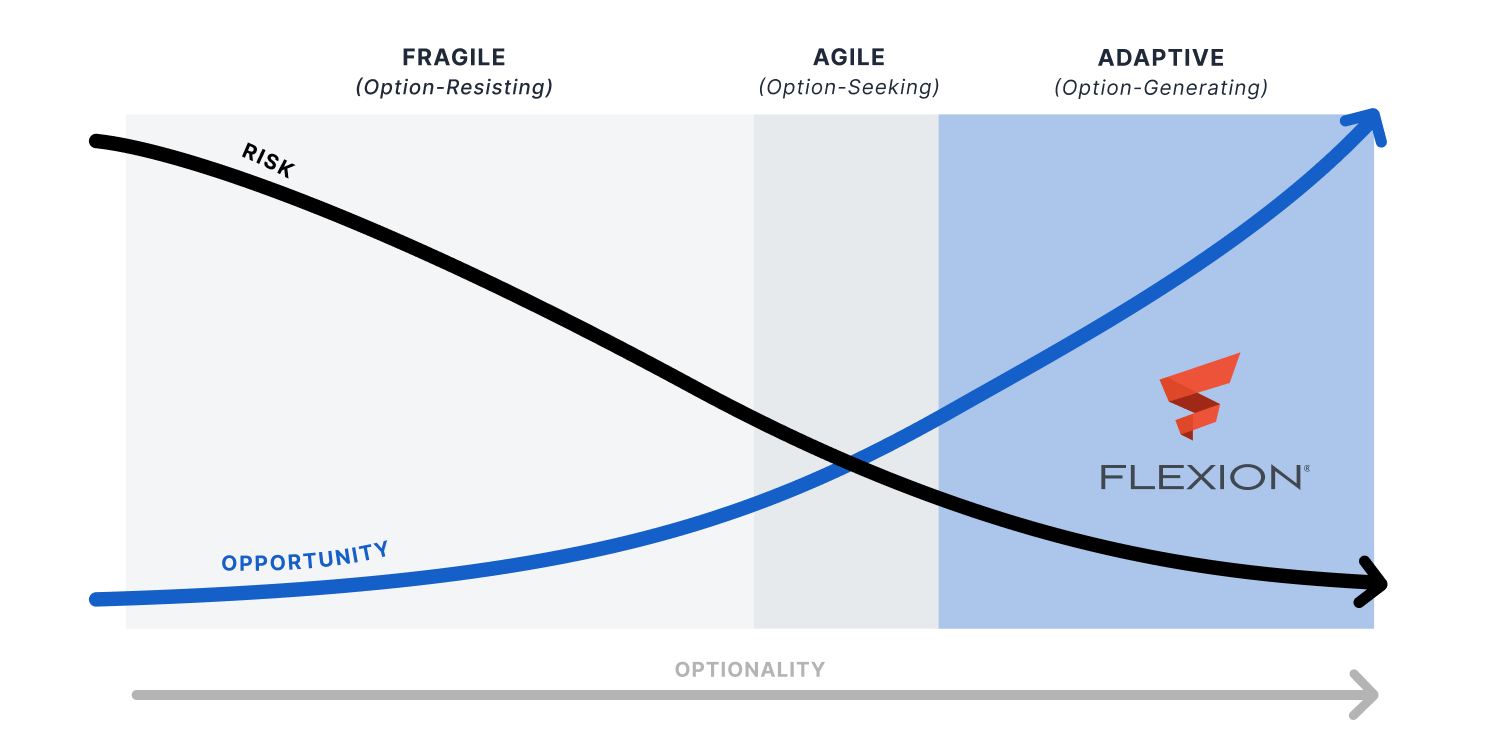
Visualize a spectrum: On the left, resisting options breeds fragility, leaving development systems with no room to maneuver, greatly increasing risk. In the middle, agile strikes a moderate balance, helping teams avoid outright failure. In the adaptive zone to the right, greater optionality proactively multiplies paths, reducing risk and making it possible to seize unexpected opportunities.
In the Adaptive zone, more trails mean more chances for serendipity, such as discovering a new, valuable feature from an overlooked integration or repurposing a discarded prototype. As Nassim Nicholas Taleb calls it, this “antifragile” state thrives on disruption, giving you an edge with more paths than your rivals.
Create adaptive software systems for lasting impact
Traditional methods leave you vulnerable to disruption. Adaptive delivery builds resilience by creating many paths forward. Adaptive systems are not just about being fast; they are about being in many places at once.
They eliminate risk and help you seize new opportunities as they appear. With this mindset, organizations use change to their advantage. They repeatedly turn risk into innovation.
But building this capability is hard. It requires a steady, step-by-step approach to change within and around the systems development process. Flexion has spent years learning this and continues to learn daily. The challenge is technical, social, and cultural. At Flexion, we have led this thinking. We make sure technology empowers, not limits, your teams.
Published on Sep 22 2025
Last Updated on Jul 12 2026