

3 AI operating models every technology leader should know

Most technology leaders know their organizations are using AI. Fewer can say precisely how.
Tools are in use, prompts are circulating, and someone is calling the initiative “AI-first” in the strategy deck. But there is a gap between using AI and having a coherent operating model built around it, and that gap is where most transformation efforts quietly stall.
The framework here is not a maturity ladder. It is a map. The question it answers is deceptively simple: where does AI sit in the work?
Key takeaway: There are 3 distinct AI operating models: Assisted, First, and Native. They differ not in how much AI a team uses, but in which layer of the work AI operates. Choosing the right model means matching it to where your actual bottleneck is, not reaching for the one that sounds most advanced.
After reading this, you will be able to:
- Identify which model your team is actually running, not which one you think you are running
- Explain the 2 observable cuts that separate the models from each other
- Apply a 3-question diagnostic to any workflow
- Avoid the most common misclassification: Calling an AI-first AI native
The core question: Which layer does AI occupy?
The 3 models are separated by 2 observable cuts, not by a gradient of intensity. AI can live in an individual’s toolkit, in the execution layer of a redesigned workflow, or in the coordination layer where work gets organized before anyone starts doing it. Those are different configurations with different implications for team structure, process design, and what breaks when AI is unavailable.
The first cut, from Assisted to First, is about who produces the work. The second cut, from First to Native, is about who coordinates it. Most discussions of AI maturity collapse this into a single dimension. That is why teams misclassify themselves.
AI-assisted: AI in the individual’s toolkit
In an AI-assisted model, existing workflows, roles, and processes stay intact. A developer uses Copilot to accelerate coding. A writer uses ChatGPT to sharpen a draft. A manager summarizes meeting notes in thirty seconds instead of thirty minutes. The gains are real, but they are local and linear: each person’s productivity increases while the organizational bottlenecks remain exactly where they were.
The tell is clean: if AI is optional for any individual on the team, you are AI-assisted. Optionality reveals that many “AI initiatives” are subsidized individual habits, not team capabilities. Turn off the tools and people grumble, then carry on. Nothing about the team’s process assumed the AI was there.
This is not a failure state. For low-volume, highly variable, or low-stakes work, redesigning a process to be First or Native costs real investment in workflow architecture, context engineering, and habit change. If that investment doesn’t pay back, Assisted is the correct fit. Many teams that describe themselves as AI-first are, on close inspection, AI-assisted with extra enthusiasm in the strategy deck.
AI-first: AI in the execution layer
AI-first requires a deliberate design choice made before building anything: what should humans actually be doing here, and what should AI handle? The workflow is intentionally restructured so AI executes the work, and humans shift toward directing, validating, and deciding. Data and context are made machine-readable by design, not as an afterthought.
We saw this play out on a federal healthcare modernization project, where the team redesigned its delivery workflow, so AI handled first-draft production across multiple workstreams, with engineers shifting to review, integration, and judgment calls. The result was daily production deployments and 100% test coverage maintained throughout, outcomes that required not just better tooling but a genuine restructuring of who did what.
The shift in human contribution is real and often uncomfortable. Experienced practitioners who are excellent producers discover that directing and validating output they didn’t produce is different work from producing it themselves. This is not a skill gap to be corrected. It is a dispositional difference that has to be matched to role and negotiated openly. Some people prefer producing; others find directing more natural. Neither is wrong, but pretending the difference doesn’t exist is how AI-first transitions stall.
Turn off AI in an AI-first environment and the redesigned workflow stalls. The execution assumed AI in the loop. The value ceiling here is high, but reaching it requires genuine workflow redesign. Bolting AI onto an unchanged process produces AI-Assisted results regardless of what the initiative is called.
AI-native: AI in the coordination layer
The boundary between First and Native is the cut most frameworks get wrong. It is not about more AI, deeper integration, or better prompts. It is about whether AI crosses from doing the work into helping organize the work.
In an AI-native model, AI participates in the coordination layer: decomposing tasks, routing context between steps, orchestrating review, and enforcing workflow standards. The team’s process, artifacts, and tools are designed from the start with AI in that role. Quality standards are enforced structurally through configuration files, specialized agents, and CI pipelines (automated systems that run quality checks every time code changes), rather than by individual discipline applied case by case. Our own use of structured agent configurations and CLAUDE.md-style enforcement files at Flexion is a practical example: AI holds part of the coordination layer, but humans defined what it enforces.
This is not autonomous pipelines running without human oversight, where humans only touch the endpoints. That model exists in narrow, well-instrumented domains and is a fragility risk, not a pattern to copy. Most teams that describe it as a goal have not thought carefully about what breaks when the automation is wrong. AI-native means AI participates in coordination while humans still set the rules and own the decisions. The distinction matters: when AI turns off in a Native environment, the process itself breaks, not because the business is automated, but because the team’s way of working assumes AI is present in both layers.
The conditions that make AI-native worth the investment are specific: coordination overhead must be the actual bottleneck, the work must recur often enough to amortize the structural investment, and the team must be willing to do the systems thinking required to define what AI enforces and what remains human judgment. When those conditions hold, the leverage is significant. When they don’t, AI-native is expensive infrastructure for a problem that doesn’t exist.
Choosing the right fit for your team
The 3-question diagnostic:
- Turn-off test. What happens when AI goes offline? If people grumble and carry on, you are Assisted. If the redesigned workflow stalls, you are First. If the process itself breaks, you are Native.
- Layer test. Where does AI sit? An individual toolkit is Assisted. The execution layer is First. Coordination plus execution is Native.
- Bottleneck test. Where is the actual constraint? Individual productivity suggests Assisted is sufficient. Execution throughput suggests First. Coordination overhead suggests Native.
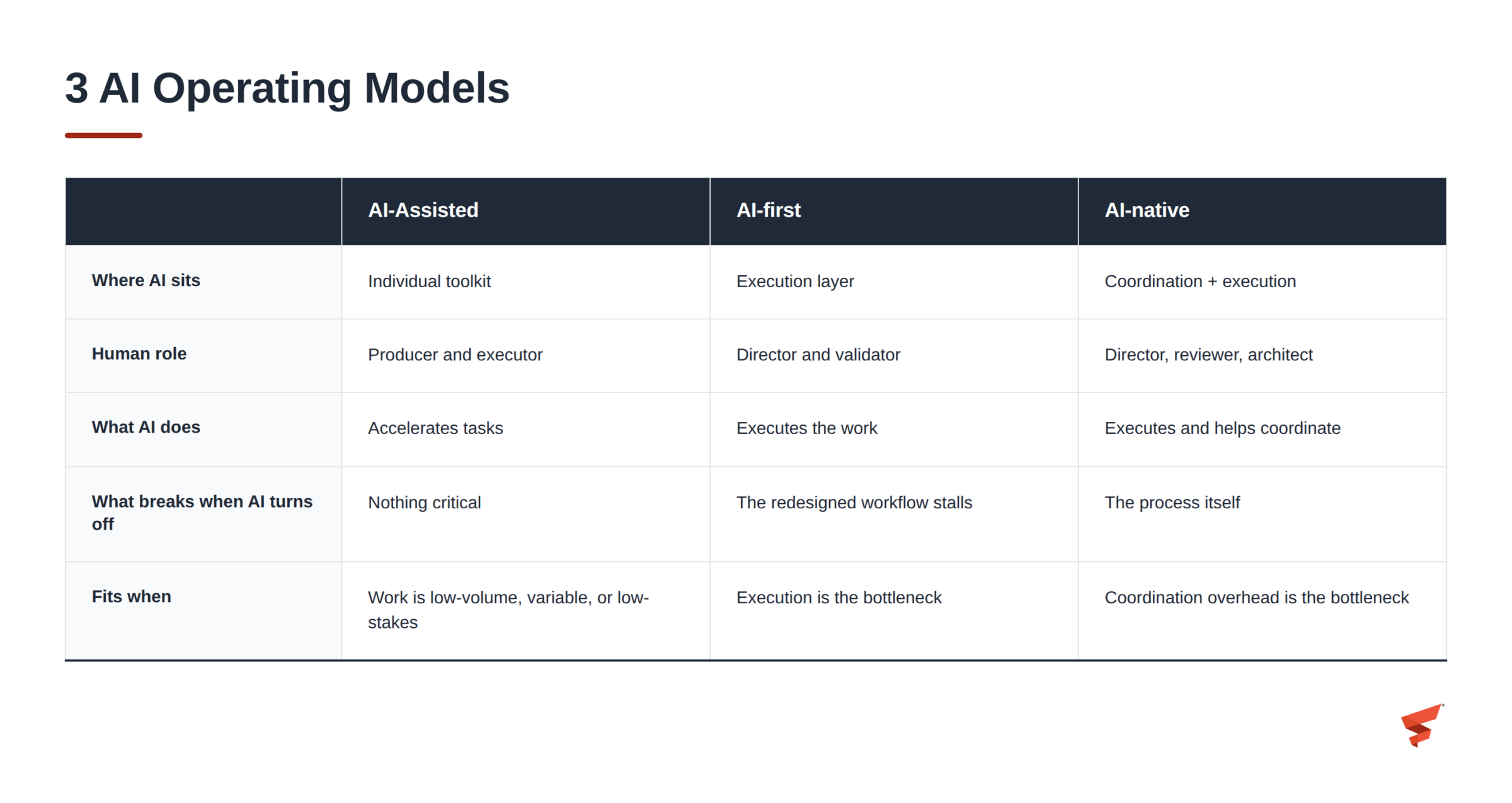
The right answer varies by workflow, not by organization. A team can be AI-Assisted in one process, and AI-native in another, and that can be exactly right. The goal is not to maximize the model number. The goal is to match the model to the bottleneck.
For technology leaders evaluating where their teams actually sit, a related pattern worth examining is how adaptive software delivery and option-enabling architecture (designing systems so future changes stay cheap) create the structural conditions that make AI-native viable rather than fragile. The same principles that make software systems adaptive make AI-integrated teams adaptive: feedback loops, preserved options, and structure that enforces decisions rather than relying on individual discipline to remember them.
If your team is working through where AI fits in your operating model, Flexion’s work on AI-powered teams picks up where the framework leaves off.
Published on Jul 15 2026
Last Updated on Jul 22 2026