TeachRock: Expanding classroom access through intelligent differentiation

TeachRock, a nonprofit founded by renowned musician Stevie Van Zandt, has transformed classrooms by using music as a gateway to learning across subjects, from history and science to math and social studies. With more than 1 million students reached and over 1 million downloads, the platform has become a widely trusted open educational resource.
As its reach expanded, TeachRock faced a fundamental challenge shared by nearly every education provider: how to ensure that a single lesson can meet the needs of a highly diverse classroom.
Flexion partnered with TeachRock and its educator community on a proof of concept (POC) to explore how AI could make that possible, without increasing teacher burden or introducing risks around student data.
Challenge
In classrooms, differentiation isn’t optional; it’s required. Teachers adapt materials for students reading below grade level, for multilingual learners, and for those who need additional scaffolding or enrichment. But in TeachRock’s case, that work happens almost entirely outside the platform.
Teachers download lessons, reformat them, rewrite sections, and manually add supports. While effective, this process is time-consuming. As TeachRock teachers noted through interviews and survey feedback, adapting TeachRock materials often requires downloading the materials, rebuilding them entirely in another format, and then embedding them in existing learning management systems.
At the same time, TeachRock has already been envisioning a next-generation platform that would improve usability, accessibility, and personalization through thoughtful AI integration.
The question wasn’t whether differentiation was needed; it was how to make it scalable, practical, and aligned with real classroom workflows.
Approach
Rather than proposing a theoretical solution, Flexion and TeachRock grounded the work in a focused prototype built around a simple guiding idea: “one lesson, many supports.”
The team worked directly with real TeachRock lessons and collaborated with TeachRock educators to understand how lessons are used in real classrooms, examining the lesson structure, what could be adapted, and where constraints, such as licensing or primary source integrity, needed to be respected. From there, the goal was not to automate teaching, but to support it in ways that align with how TeachRock educators already work.
The prototype embedded AI directly into the lesson experience, allowing teachers to generate and apply supports within workflows informed by TeachRock educator input. Every output allowed space for teacher review and approval, reinforcing a human-in-the-loop model that preserved instructional control and trust.
Just as importantly, the system avoided collecting or storing student data. Instead, it introduced the concept of teacher-defined group profiles, enabling differentiation at scale without introducing privacy risks.
Outcomes
The prototype, developed collaboratively by Flexion and TeachRock, combines working software with simulated outputs to demonstrate the full experience and demonstrates how a single TeachRock lesson can dynamically expand into multiple tailored versions, each aligned to different learner needs, but all grounded in the same core content.
At the center of the experience is a simple but powerful shift: instead of rewriting lessons from scratch, teachers can define the needs of their classroom and let the system generate appropriate supports.
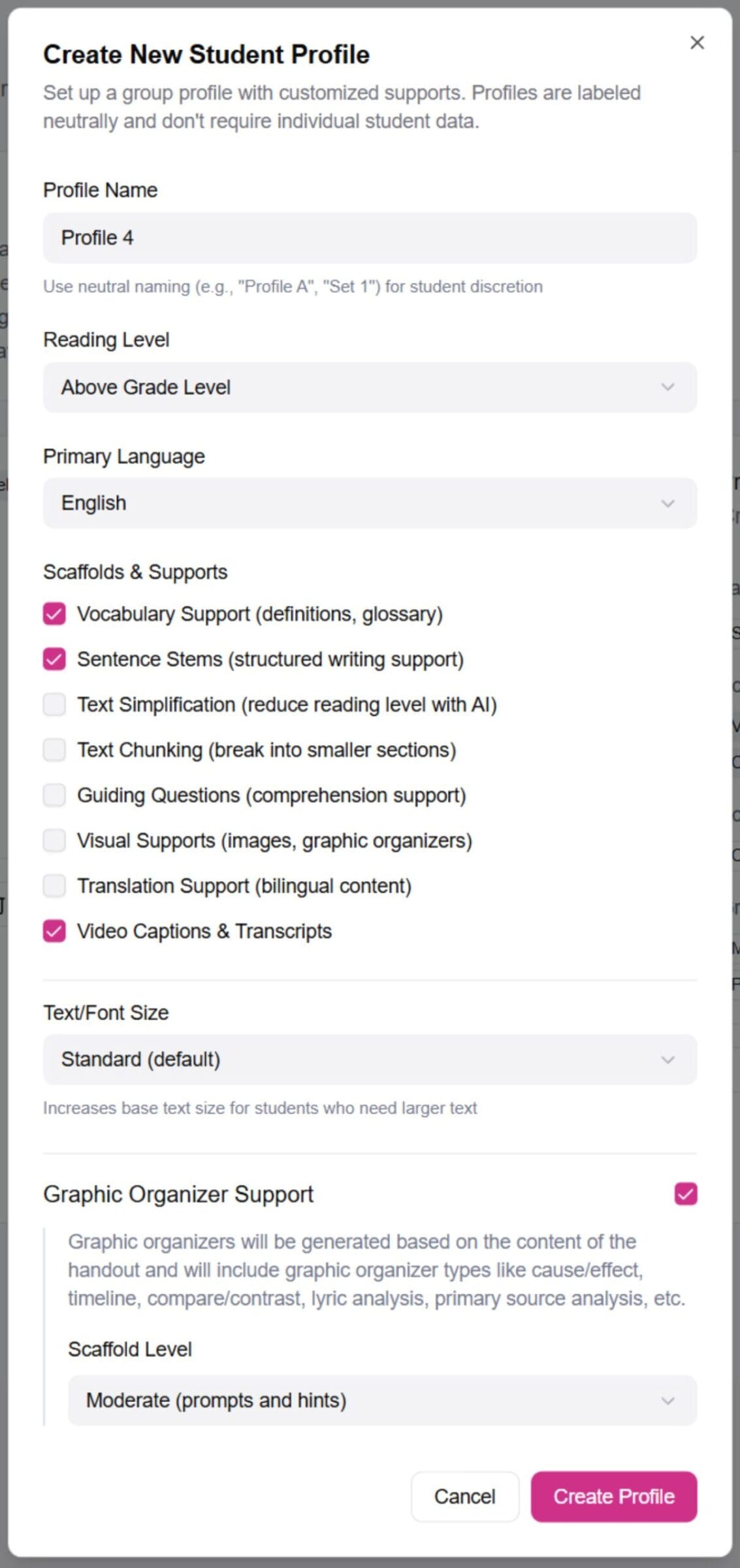
Create Student Profile modal showing how teachers can create reusable student profiles to instantly tailor lessons, adjusting reading level, language supports, scaffolds, and accessibility settings without collecting individual student data.
Feature validation from teacher surveys
100% of teachers valuedReading level supports
Vocabulary supports
ESL/language supports
Graphic organizers
Visual supports
Teachers create reusable student group profiles that reflect common classroom needs, such as student reading level, language support needs, and preferences for more visuals and scaffolding. These student group profiles can then be applied across lessons, reflecting real differentiation strategies already used by TeachRock teachers and reducing repetitive work while maintaining flexibility.
Once a profile is selected, the system generates draft adaptations aligned to those needs. These adaptations might include simplified text, embedded vocabulary support, chunked content, or comprehension support, all designed to make the material more accessible without altering its core meaning. These outputs vary in quality and often require refinement, reinforcing the importance of teacher review and content oversight.
To make the reading level differentiation transparent and usable in practice, the prototype presents them in a side-by-side format.
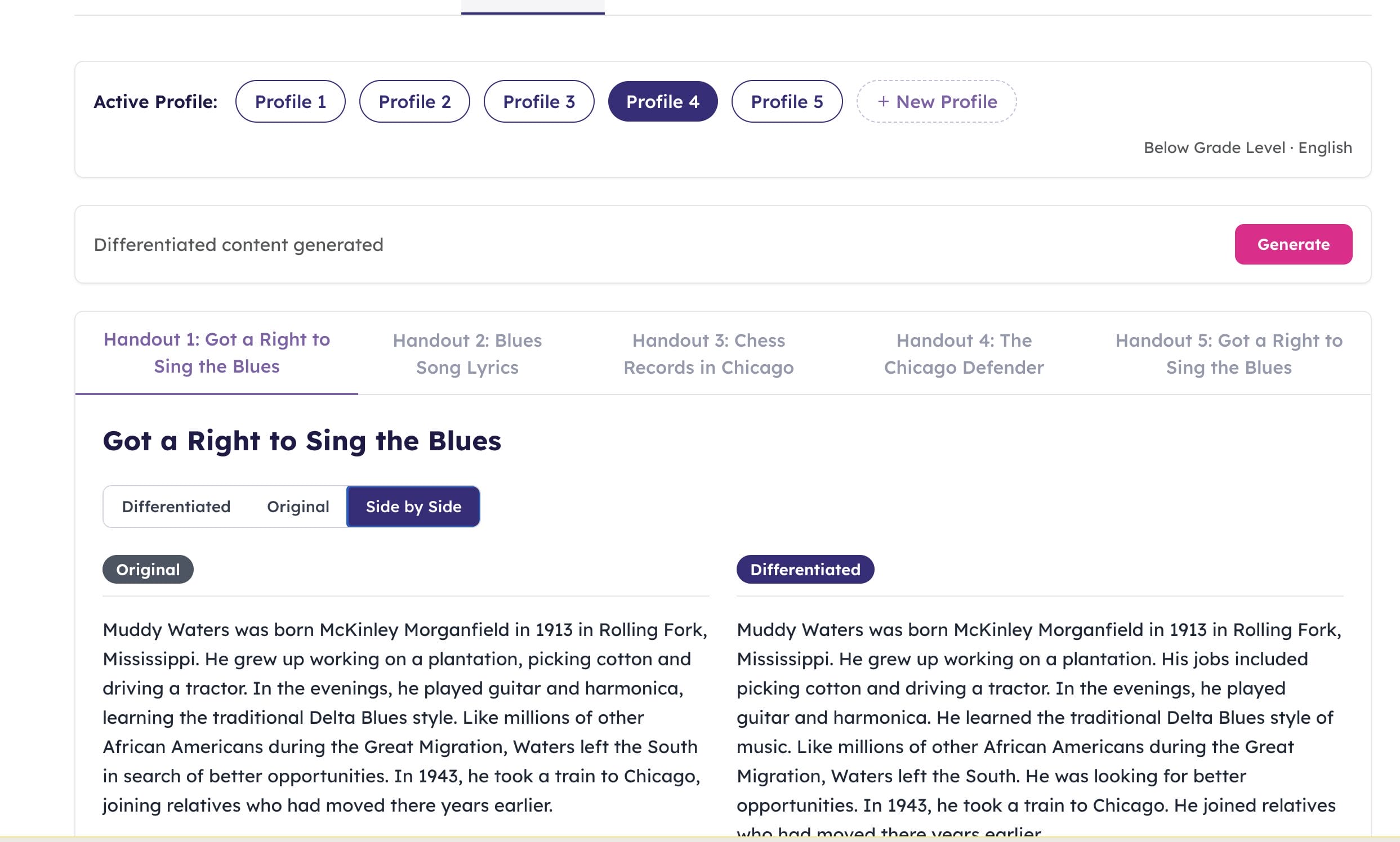
This side-by-side structure reflects a key priority raised by TeachRock educators: preserving original materials while adding supports around them, such as vocabulary or comprehension support, moving beyond text adaptation into more interactive learning tools.
For example, a Blues lesson that includes Muddy Waters’ Burr Clover Farm Blues lyrics, the system generates a lyrics analysis organizer to help students interpret Muddy Waters’ music as they read and listen.
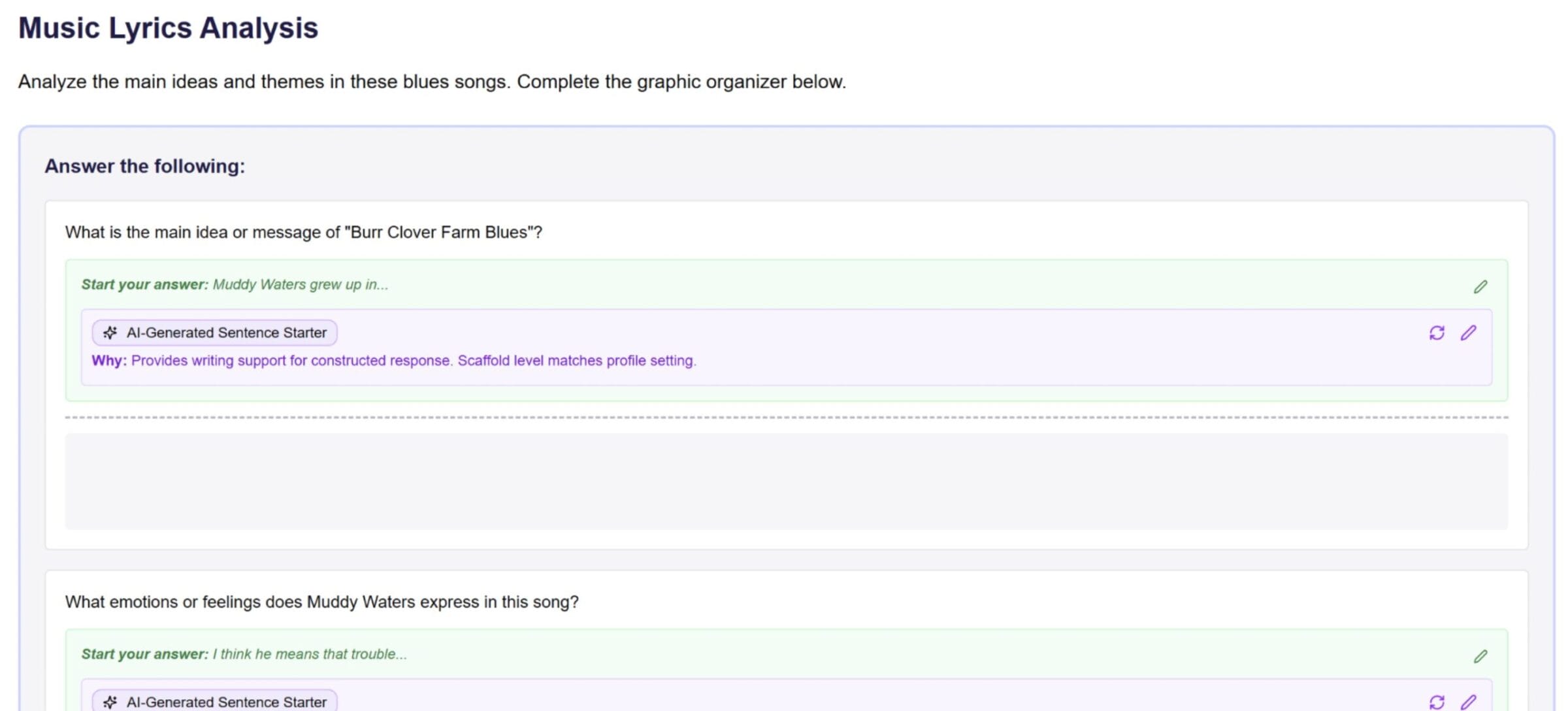
A dynamically-generated graphic organizer adapts to the lesson and selected student profile, providing targeted supports. All AI-generated content is tagged and includes a rationale.
Teachers can edit, regenerate, or remove supports in real time. For example, here, a lyrics analysis organizer was selected to help students interpret Muddy Waters’ music as they read and listen.
To extend beyond pre-configured supports, the prototype also explores an AI assistant that helps teachers generate additional supports on demand. Rather than starting from scratch, teachers can ask for specific enhancements tied to the lesson context, such as adding a movement break or generating scaffolded questions.
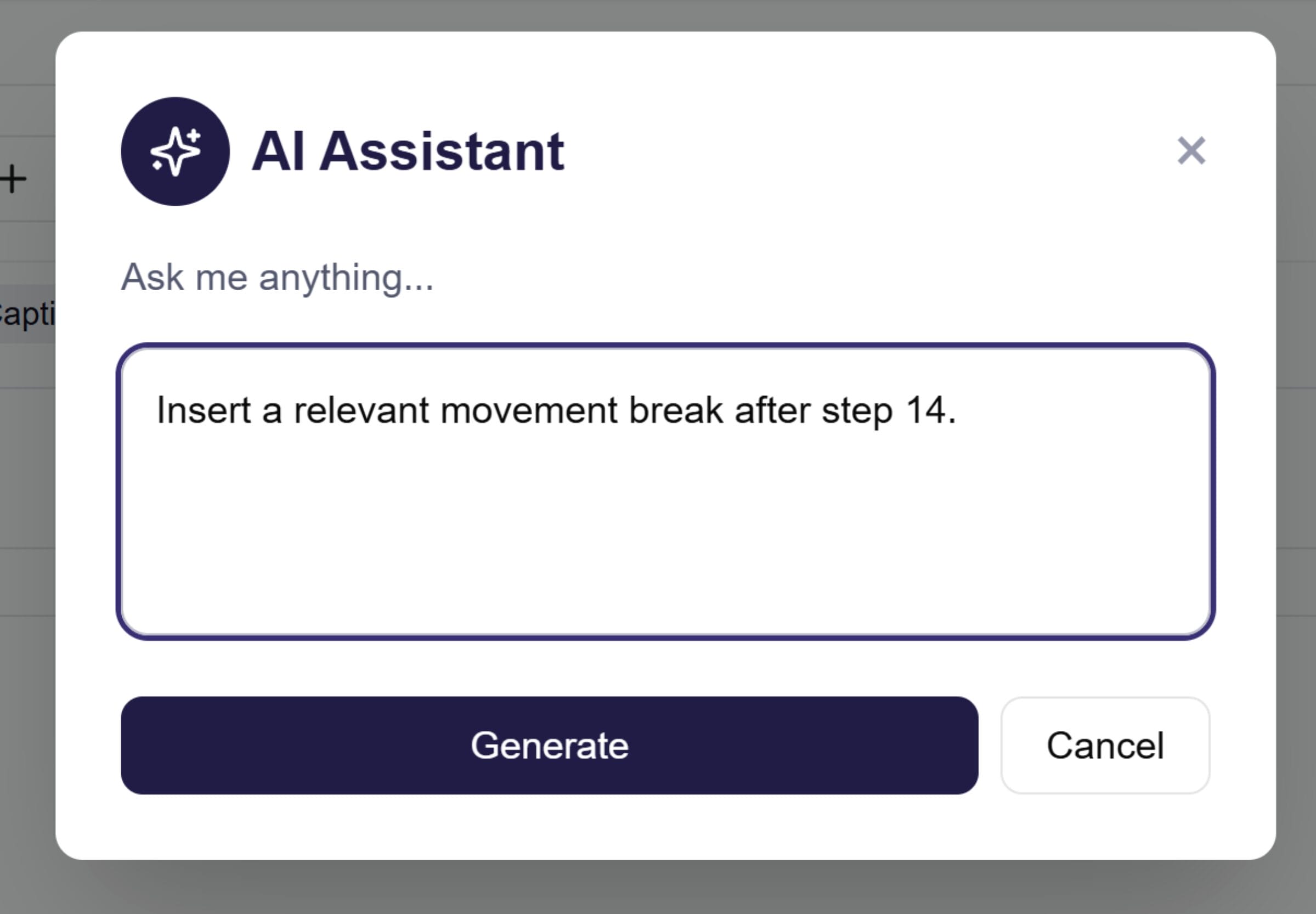
An embedded AI assistant helps teachers quickly generate contextual supports, like adding a movement break, directly within the lesson workflow.
These suggestions are not applied automatically. Teachers review, edit, and approve everything before it is used, ensuring that AI acts as a collaborator rather than a replacement.
Finally, the system connects directly to how teachers already deliver instruction. Once differentiated versions are ready, they can be downloaded, printed, or shared through learning management systems.
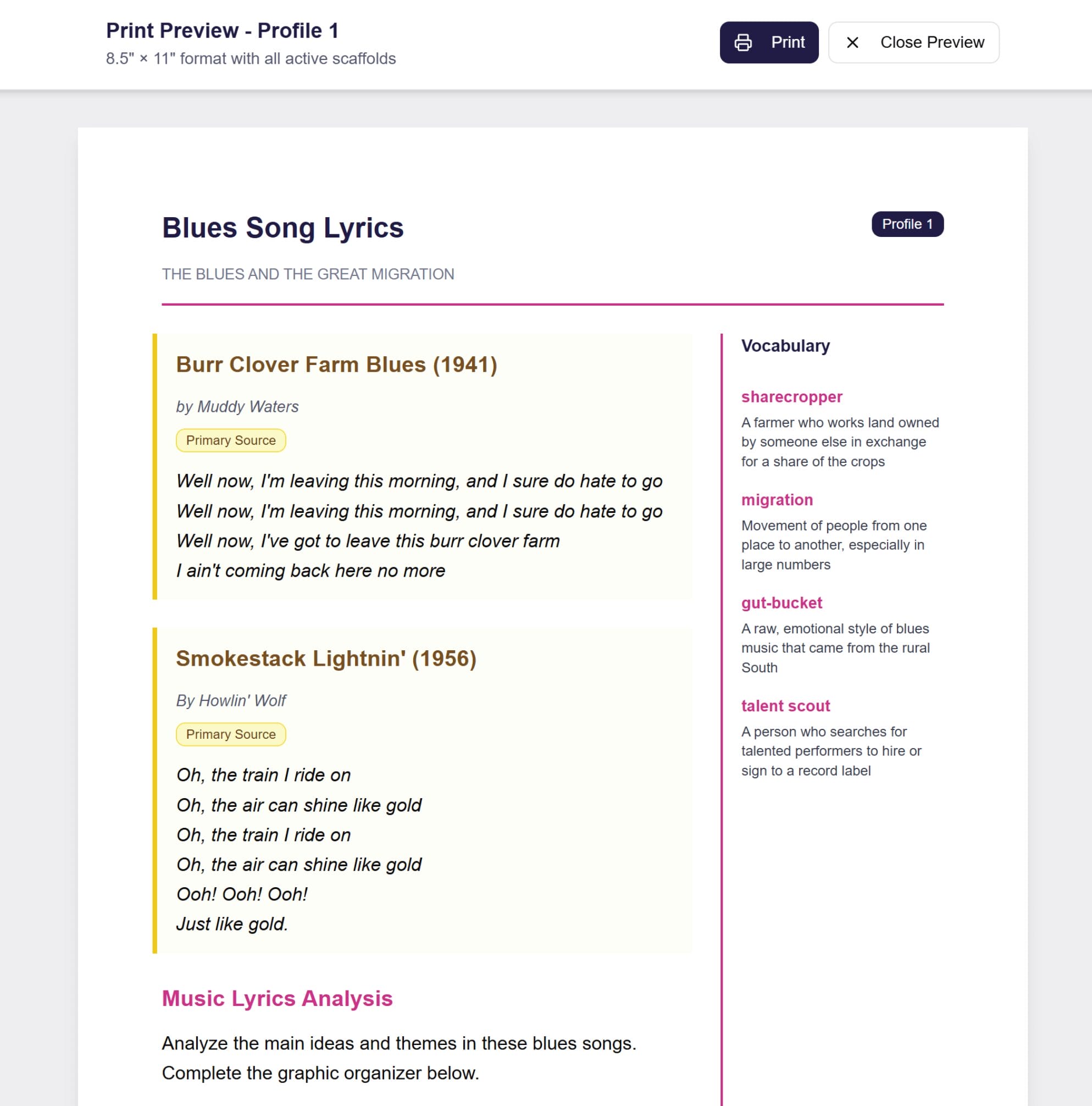
Print preview showing how differentiated versions can be printed or exported, with neutral labeling (“Profile 1,” “Profile 2”).
This approach begins to align with how TeachRock teachers deliver instruction by bringing differentiated materials into their classrooms, whether digitally through platforms like Google Classroom or as printed handouts.
Impact
Even within a short timeframe, the POC validated both the concept and its practical value.
TeachRock teachers responded strongly to the idea of having differentiation built directly into TeachRock, rather than relying on external tools. Early feedback showed a high perceived usefulness, with particular enthusiasm for reusable profiles that simplify lesson preparation over time.
“The learner profiles help differentiate instruction, meet
IEP and 504 goals, and get more out of the lessons.
It is helpful to have suggested scaffolds… at least to
have a place to start to get ideas. The differentiation
options will be very useful.”
High School ELA Teacher
“It keeps everything within TeachRock…
which would ultimately enhance the content overall.
I loved the differentiation and the privacy aspect of it.”
High School Music Appreciation Teacher
The prototype also demonstrated that AI-powered differentiation is not only feasible but can be implemented in a way that respects key constraints, including protecting primary sources, avoiding student data collection, and maintaining teacher control.
Perhaps most importantly, the work confirmed that this approach aligns with how teachers actually operate. By fitting into existing workflows rather than disrupting them, the solution lowers the barrier to adoption and increases the likelihood of meaningful classroom impact.
What’s next
The POC established a clear foundation for future development. In the near term, the greatest opportunity lies in making differentiated materials easier to export, edit, and assign within existing teacher workflows, including through platforms like Canvas and Google Classroom.
Looking ahead, TeachRock can build on this foundation in collaboration with its educator community by developing a more structured content system, expanding AI-supported recommendations, and refining guardrails for sensitive content areas. Over time, this could evolve into a fully integrated platform that supports not just access to content, but meaningful engagement for every learner.
Conclusion
In just a few weeks, Flexion and TeachRock worked together to move from an ambitious idea to a tangible, working prototype. The project demonstrated that scalable differentiation is not only possible but practical when it is grounded in real classroom needs and designed with teachers at the center.
By beginning to make “one lesson, many supports” tangible, this work begins to empower teachers to create more personalized learning experiences, enabling every student to engage with the same powerful content on terms that work for them.
Ready to change the way you’re doing business?
Contact us to talk about how Flexion can help your organization drive efficiency, optimize costs, and achieve your technology goals!