

8 fundamentals shaping Flexion’s culture
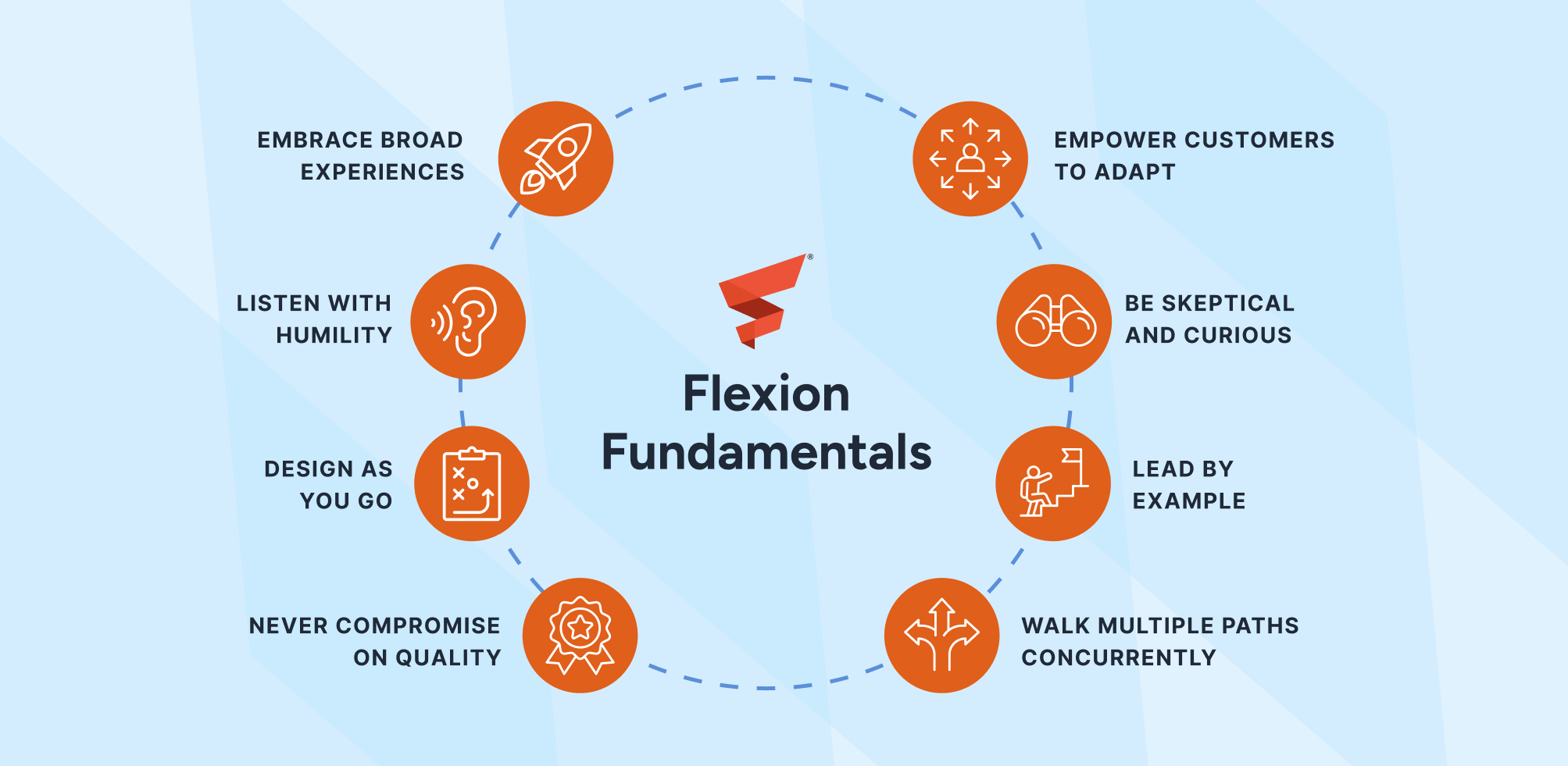
At Flexion, the 8 Flexion Fundamentals aren’t a poster on the wall; they’re the working principles that shape how our teams build software, partner with government and commercial clients, and grow alongside one another. They’re the reason a discovery conversation, a sprint review, and an interview can all feel recognizably “Flexion.”
Our aligning narrative serves as the true north for all Flexion Fundamentals. Without it, our operating principles would lack a clear, unifying purpose and could easily drift into generic, feel-good “apple pie” values that sound nice but provide little real guidance. It reads:
Our work is ruled by complexity and unpredictability; our ability to adapt and respond to inevitable surprises is the difference between success and failure. So we seek multiple options to solve our most challenging problems as they arise, creating several possibilities for success. This not only reduces risks but opens up new opportunities.
The Flexion Fundamentals exist to make this reality concrete in our daily decisions, behaviors, and systems, ensuring every principle directly supports our capacity to thrive amid uncertainty rather than merely checking a box for conventional “good company” ideals
For potential clients, the fundamentals offer a clear sense of how we approach complex problems. For candidates, they describe the culture you’d be joining. This article walks through each fundamental, what it looks like in practice, the thinking behind it, and why we keep returning to it.
Most organizations treat culture and product delivery as separate concerns. Values live in the handbook, and product lives in the codebase. Flexion is built on the conviction that, for complex work, the two are the same thing.
The missions we take on across software modernizations, data-intensive platforms, and public- and private-sector systems whose users and policies keep evolving rarely come with stable answers, and the products we build have to evolve alongside them.
That reality shapes how we organize, how we approach products, how we architect, and how we hire. The eight fundamentals that follow aren’t aspirational statements about who we’d like to be; they’re the working behaviors that make adaptive delivery possible. They’re how we keep options open, surface tradeoffs early, and leave clients more capable than we found them. Read them as a description of how we think and how we engineer at Flexion; the two are inseparable, and that’s the difference clients tell us they notice first.
Key takeaway:
Flexion’s 8 fundamentals form the cultural backbone that connects how we hire, deliver, and partner, anchoring every decision in humility, quality, and adaptability. What the fundamentals do at Flexion:
- Shape decisions at every level, from architecture to staffing
- Reinforce collaboration across a range of perspectives
- Hold quality and curiosity as non-negotiable standards
- Build flexibility, because complex work demands it
1. Embrace broad experiences
Complex problems rarely yield to a single perspective. Our first fundamental commits us to bringing broad experiences and backgrounds to actively collaborate on hard problems in real time, and to building environments where dissenting and unconventional opinions are welcome, not just tolerated.
The principle behind it is well-established. Research compiled by Scott Page in The Diversity Bonus shows that teams with cognitively diverse members consistently outperform homogeneous teams on prediction and problem-solving tasks, particularly when the work is non-routine. Software modernization, agency transformation, and the data-heavy missions we typically support are exactly that kind of work.
In practice, embracing broad experiences shows up in three places at Flexion.
- First, in staffing, we look for teams that pair technical depth with adjacent expertise, domain knowledge, research, design, operations, and lived experience with the user community.
- Second, in meetings, facilitators explicitly invite minority views before consensus forms, and we treat “I see this differently” as a contribution, not a disruption.
- Third, in retrospectives, we audit decisions for blind spots and ask who wasn’t in the room. The point isn’t to celebrate differences for their own sake; it’s to make sure the team has the range it needs for the problem in front of it.
2. Listen with humility
Listening with humility means we listen and reflect before voicing opinions. In complex situations, we defer to the people closest to the problem, often the users, operators, and frontline staff, and we seek direct feedback from teammates and clients, even when it’s uncomfortable.
The discipline draws on what organizational psychologist Edgar Schein called Humble Inquiry: asking questions to which you do not already know the answer, and building a relationship based on curiosity and interest. It also borrows from David Marquet’s leadership work in Turn the Ship Around!, which demonstrated how shifting authority and listening to the people doing the work produce both better decisions and stronger teams.
What this looks like at Flexion: we structure user research and stakeholder interviews into the start of every engagement, even on technical refactors, because the people maintaining a system know things no architecture diagram can capture.
We practice “stay curious longer”, holding back recommendations until we’ve actually heard the problem in the user’s words. And we make feedback a routine, not an event: we run regular pulse checks with clients, hold open retrospectives, and ask our teammates the question that’s hardest to ask, “What should I be doing differently?” Humility isn’t passivity. It’s the discipline of slowing down long enough to learn before acting.
3. Design as you go
Meaningful work changes user needs, and key details emerge during delivery. So we design as we go, staying flexible by separating the what from the how. Rather than freezing a design up front, we evolve it as we learn, keeping options open and risk contained.
This approach reflects our belief that good architecture is more journey than destination. Robert C. Martin captures the idea in Clean Architecture: “Good architecture comes from understanding it more as a journey than as a destination, more as an ongoing process of inquiry than a frozen artifact.” We’ve taken that thinking further with what we call Option-Enabling Software Architecture (OESA), an internal discipline for separating what a system does from how it does it, particularly in the areas most likely to change as a mission evolves.
The payoff is concrete. When a client’s priorities shift mid-engagement, a new mandate, a new dataset, or a new user population, we don’t have to unwind months of premature commitments. We swap implementations behind stable interfaces, route around bottlenecks, and surface tradeoffs early. Designing as we go is what makes our software soft again: easy to change, easy to repurpose, and easy to hand off when our work is done.
4. Never compromise on quality
We work to eliminate design and development debt across every deliverable. We minimize and simplify to increase understanding, and we automate the right processes to reduce unintended variation. Quality, for us, isn’t a polish step at the end; it’s a habit built into how we plan, build, and review.
The economic case for this is well documented. Studies summarized by Capers Jones and others have repeatedly shown that defects caught during design or early development cost a fraction of those caught in production. The cultural case is just as strong: in Accelerate, Forsgren, Humble, and Kim found that the highest-performing software teams aren’t the ones that move fastest at the expense of quality; they’re the ones whose quality practices enable speed.
At Flexion, the operational expression of this fundamental is concrete. We use continuous integration and automated testing as a baseline, not a stretch goal. We treat refactoring as routine maintenance, the way an aircraft mechanic treats inspection. We pair, review, and rotate ownership to keep knowledge from concentrating in a single head. And we name and track debt, technical, design, and process, so leadership can decide what to address, not whether to acknowledge it. The result is software that holds up when conditions change, which, on our projects, they always do.
5. Empower customers to adapt
We deliver value continuously and build long-term flexibility into what we ship. That includes assessing what works, surfacing tradeoffs, and helping clients understand their options. Our goal is to leave teams more capable than when we found them, able to make informed decisions long after our engagement ends.
This principle borrows from lean and continuous-delivery thinking pioneered by Eric Ries and Jez Humble: small, frequent releases coupled with measurement let teams learn what’s actually valuable, instead of guessing at requirements months in advance. Combined with the architectural flexibility from fundamental 3, it means clients aren’t locked into the path we set on day one.
In practice, this shows up as living documentation, “show your work” demos that include the reasoning behind decisions, and active knowledge transfer to client engineers, product owners, and analysts. We explicitly avoid creating a dependency on Flexion as a vendor. We brief clients on emerging risks and options before they become decisions, and we leave behind playbooks, tests, and architectural guardrails that travel with the team. Adaptability is a transferable skill, not a service we keep to ourselves.
6. Be skeptical and curious
We don’t take things at face value. We dig into root causes and challenge assumptions, especially our own. Curiosity keeps us learning so we can expand the options available to clients. Skepticism keeps us honest about what we know and what we’re still working out.
These two habits are inseparable. Karl Popper argued that knowledge advances not by proving ourselves right but by actively trying to prove ourselves wrong, a posture that protects against the most dangerous thing in complex work: confident, untested assumptions. Toyota’s “5 Whys” pushes the same idea into operations: keep asking why until you reach a cause you can actually change.
At Flexion, skepticism shows up as the question “how do we know?” applied to backlog items, status reports, and architectural recommendations, including our own. It shows up in our preference for measurement over assertion, and in our willingness to challenge a stated requirement when the underlying need points somewhere different. Curiosity shows up in our weekly Options and Experiments (O&E) meeting, where teammates share things they tried, surprises they ran into, and ideas worth borrowing. We treat learning as part of the deliverable, not as overhead.
7. Lead by example
We take initiative and hold ourselves accountable. But we also know success isn’t a solo act, so we ask for help, offer it generously, and learn out loud when things go wrong. Leadership at Flexion isn’t a title; it’s a daily practice.
The model is closer to Robert Greenleaf’s servant leadership than to traditional command-and-control. Leaders, at every level, exist to remove obstacles, model the behaviors we expect, and create the conditions for the team to do its best work. Amy Edmondson’s research on psychological safety reinforces why this matters: teams perform better when people can admit mistakes, ask “naive” questions, and propose half-formed ideas without fear of being penalized.
Leadership is something we practice together every day. By practice, we mean:
- Senior staff is visible in the work, not just above it.
- Project leads share credit publicly and absorb criticism privately.
- We conduct blameless retrospectives that focus on systems and signals, not individuals.
- We expect every Flexion teammate, not just those with management titles, to demonstrate ownership, raise concerns early, and offer help across teams.
8. Walk multiple paths concurrently
When solving complex problems, we can’t predict which ideas will work. So we pursue multiple options at once, amplifying what works and dampening what doesn’t. This approach reduces the risk of betting on a single solution and increases the chance of finding a better one.
The underlying idea, drawn from real options theory in finance and from biological evolution, is that in genuinely uncertain environments, parallel exploration beats serial commitment. You can’t reason your way to the right answer when the answer depends on a future that hasn’t happened yet. You have to try things in small enough bets that you can learn from the failures and double down on the successes.
At Flexion, this fundamental shapes how we frame risk. On architecturally critical decisions, we’ll often spike two or three approaches simultaneously rather than debate them on paper. On product questions, we’ll release variants, instrument them, and let user behavior settle the argument.
On organizational change, we’ll pilot in one team before scaling. The cost is a little extra coordination up front; the payoff is dramatically lower risk of a bad bet and a much faster path to discovering options nobody could have predicted at the outset. It’s how we turn uncertainty into a structured advantage for our clients.
What this means for clients and candidates
For clients, the fundamentals translate into engagements that adapt as your priorities shift, teams that ask hard questions, and software built to evolve. You’ll see them in how we frame discovery, how we explain tradeoffs, and how we measure success across the life of an engagement. They’re also why our work tends to outlive our engagements: the architecture, the documentation, and the team capability we leave behind are designed to keep paying off.
For candidates, the fundamentals describe a workplace where dissent is welcomed, learning is expected, and quality is shared work, not a heroic effort. They shape how we interview, how we onboard, and how we give feedback. New team members tell us the consistency between what we say and how we work is one of the first things they notice. We don’t claim to live the fundamentals perfectly. We claim to take them seriously, talk about them openly, and use them as the standard we measure ourselves against.
We’ll keep refining how we live the fundamentals, because adapting to change is itself a fundamental. To learn more about partnering with us on public or private sector work, please drop a line here.
If you’re exploring a role where your perspective will shape the work, contact one of our recruiters.
Published on Jun 16 2026
Last Updated on Jul 22 2026